Central order workspace
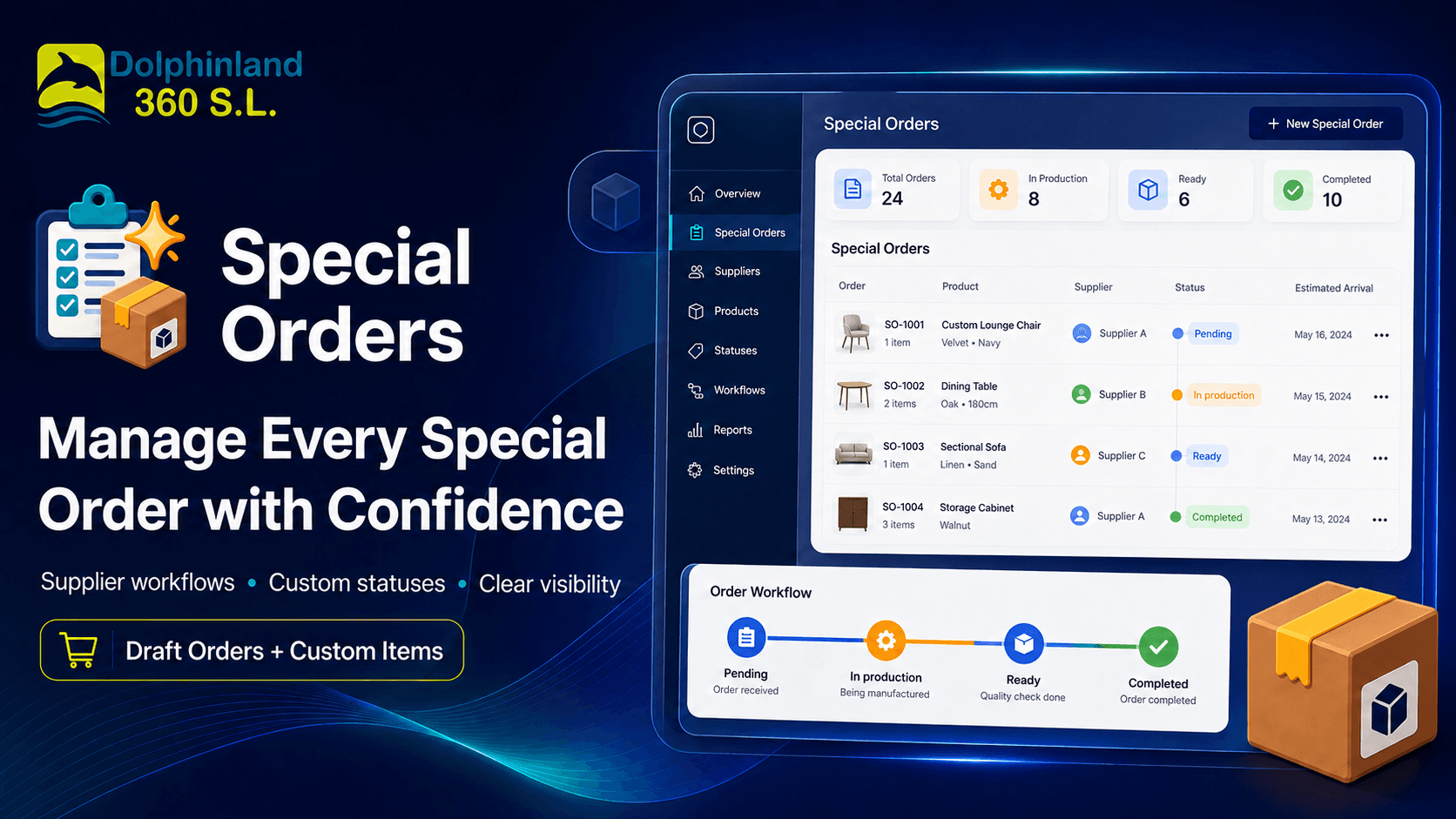
Search special orders by order number, customer, supplier, employee or item, filter them by configurable status and update status directly from the list.

Bring every special request into one Shopify workspace. Select the customer, add catalog or custom items, coordinate suppliers and staff, track progress and notify the customer when their order arrives.
What it adds
Search special orders by order number, customer, supplier, employee or item, filter them by configurable status and update status directly from the list.
Select existing Shopify customers and search the product catalog by product name, SKU or UPC without leaving the embedded app workflow.
Add catalog products or custom items, maintain a per-store supplier list and assign multiple suppliers, an employee and an estimated arrival date.
Keep internal comments and order changes in a timeline, then send a customizable arrival email through the merchant's selected provider.
How it works
Choose a Shopify customer, add Shopify products or custom items, and assign the initial status, suppliers, employee and expected arrival.
Use the shared list, search, open-order filter, configurable statuses and timeline to keep the request moving across the team.
When the requested items arrive, send the customer a templated email and record the successful notification in the order timeline.
Changelog
Follow the features included in each published version.
The first release covers the complete request-to-arrival workflow.
Help center
These guides describe the current release, including Shopify data access, store-managed settings and the notification options available to each merchant.
Read the app privacy policyApp guide
The app requests read access to customers, products and inventory, plus permission to create draft orders when an authorized user explicitly starts that action. Customer access powers the customer picker, while product and inventory access support catalog search and the item information copied into a special order.
Open DL Special Orders from Shopify admin, then review Settings before the first live request. Each store maintains its own suppliers, workflow statuses and notification configuration.
App guide
Search Shopify customers by name or email and select the customer connected to the request. If the customer does not exist, use the Shopify customer-creation action and return to the special order after the customer has been created.
Search the Shopify catalog by product name, SKU or UPC. Selected product details are copied into the special order, so later edits inside the special order do not change the original Shopify product.
Select the current status, one or more suppliers, the responsible employee and an estimated arrival date when known. An initial internal comment can provide context for the team before the order is saved.
App guide
Suppliers are records owned by the app and isolated per Shopify store. They can be created, renamed and removed from Settings. Removing a supplier from Settings does not rewrite the supplier name already stored on an existing special order.
Create and arrange statuses, choose a label and color, and decide whether each status appears in the default Open filter. Statuses can be changed from the order detail or directly from the main list.
Assign an available Shopify staff member when responsibility should be explicit. Internal comments and recorded changes form the order timeline so the team can understand what happened and who made an update.
App guide
Each Shopify store configures and manages its own sender. The current release supports Resend, SMTP, the Gmail API for Google Workspace and a custom HTTPS webhook.
Edit the subject and message in Settings. Template variables can insert the customer name, special order number, item list and current Shopify store name.
Open the saved special order and use Send notification after the items arrive. A successful delivery adds an entry to the timeline. Confirm the customer's email address and the selected sender configuration before sending.
App guide
The app opens with the Open filter. Search by order number, customer, supplier, employee or item, select another status filter when needed and open any result to review the complete request and timeline.
Confirm that the app installation still has the customer, product and inventory read scopes shown during installation. Reauthorize the app after a scope change, then retry the search from Shopify admin.
Verify the customer email, sender address and provider credentials in Settings. For Resend, confirm that the sender is verified. For SMTP, check the host, port and security mode. For Gmail, confirm OAuth send access and the authorized sender alias. Review the provider logs before retrying.
Email support@dolphinland.org with the store domain, special order number, expected result and relevant screenshots. Do not send passwords, API keys, OAuth tokens or unnecessary customer information.
Questions
It maintains a separate operational record for the special request and can create one Shopify draft order from it when an authorized user explicitly confirms the action.
Yes. A custom item only requires a name, with optional SKU, UPC, cost, price, vendor and description fields available for additional context.
Yes. Supplier records, status labels, colors, ordering and Open-filter membership are stored separately for each installed Shopify store.
The merchant configures a provider for its store. The current release supports Resend, SMTP, Gmail API credentials or a custom delivery webhook, plus a customizable notification template.
Before launch
Availability, commercial terms and individual features may evolve as the app continues to improve.